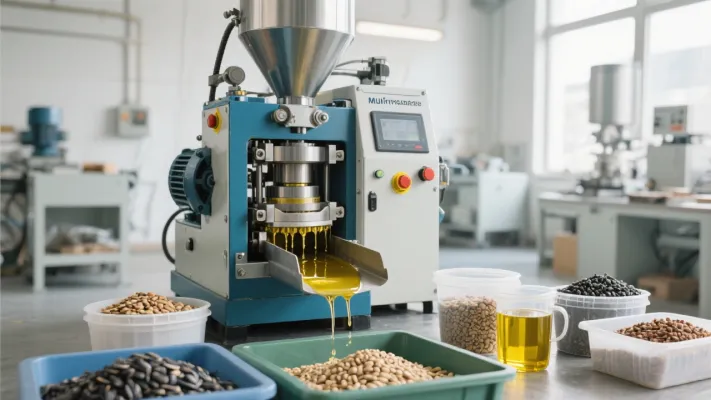
For small-scale oil producers, versatility is no longer a luxury—it’s a necessity. With rising demand for specialty oils like sesame, flaxseed, and cold-pressed canola, the ability to switch between different oilseeds without downtime or yield loss has become critical. This guide breaks down how to efficiently adapt your spiral cold press machine to process diverse crops—from soybeans to sunflower seeds—with proven technical parameters and real-world case insights.
Each oilseed behaves uniquely during extraction:
Proper pre-treatment reduces mechanical stress on equipment by up to 30%, according to field data from Indian and Vietnamese small mills. Skipping this step leads to frequent blockages, inconsistent oil quality, and increased maintenance costs.
The key lies in three adjustable parameters:
| Parameter | Recommended Range | Impact on Yield |
|---|---|---|
| Moisture Content | 6–10% | +5–12% when optimized per seed type |
| Crushing Granularity | 1.5–3 mm | Reduces clogging risk by 40% |
| Feed Rate | 0.5–1.2 kg/min | Prevents overheating and maintains consistency |
In Thailand, one family-run mill increased annual output by 22% simply by rotating crops seasonally—peanuts in summer, sesame in winter—and using our recommended parameter adjustments. Another example from Kenya shows that implementing a basic troubleshooting checklist reduced unplanned stoppages by nearly 50% over six months.
By mastering these fundamentals, small oil mills can achieve consistent yields across multiple oil types while minimizing trial-and-error time—which directly impacts profitability and customer satisfaction.
Our fully automatic spiral cold press handles all major oilseeds effortlessly—no manual tuning needed. Save time, reduce waste, and boost income year-round.
Get Your Customized Solution Now →
 227
|
227
|
 high-efficiency corn germ oil press machine
corn germ oil production process
intelligent temperature control system
physical pressing technology
oil pressing efficiency optimization
high-efficiency corn germ oil press machine
corn germ oil production process
intelligent temperature control system
physical pressing technology
oil pressing efficiency optimization
 112
|
oil pressing equipment selection
small and medium edible oil machinery
oil extraction efficiency improvement
fully automatic oil press
edible oil production equipment
112
|
oil pressing equipment selection
small and medium edible oil machinery
oil extraction efficiency improvement
fully automatic oil press
edible oil production equipment
 310
|
low energy peanut oil press
intelligent pressing equipment
peanut oil production efficiency
oil processing equipment
energy-saving oil press
310
|
low energy peanut oil press
intelligent pressing equipment
peanut oil production efficiency
oil processing equipment
energy-saving oil press
 302
|
Intelligent temperature control system
Corn germ oil pressing
High - efficiency physical pressing
Oil quality optimization
Grain and oil processing equipment
302
|
Intelligent temperature control system
Corn germ oil pressing
High - efficiency physical pressing
Oil quality optimization
Grain and oil processing equipment
 265
|
Peanut Oil Press Machine
Fully Automatic Peanut Oil Press Machine
High Efficiency Peanut Oil Press Machine
Commercial Peanut Oil Press Machine
Energy Saving Peanut Oil Press Machine
Peanut Oil Extraction Machine
Multi-functional Oil Press Machine
Oil Press Machine for Small Enterprises
Eco-friendly Peanut Oil Press Machine
265
|
Peanut Oil Press Machine
Fully Automatic Peanut Oil Press Machine
High Efficiency Peanut Oil Press Machine
Commercial Peanut Oil Press Machine
Energy Saving Peanut Oil Press Machine
Peanut Oil Extraction Machine
Multi-functional Oil Press Machine
Oil Press Machine for Small Enterprises
Eco-friendly Peanut Oil Press Machine